Docteur Anger
Felix AustriaDocteur Anger is a physician, father to Adèle, and guardian to the orphaned Stefania, whose life is marked by the fire that killed his wife and by the promise he extracts from Stefania on his deathbed. His nightmares make the catastrophe recur in his body; his care gives Stefania shelter and education; his final instruction converts their intertwined lives into a duty that continues after he is gone.
Identity and Background
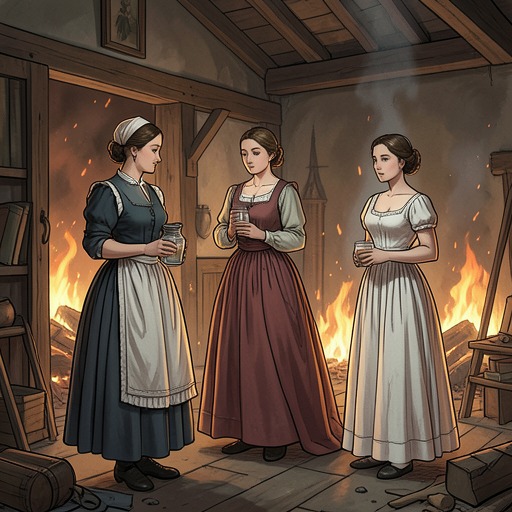
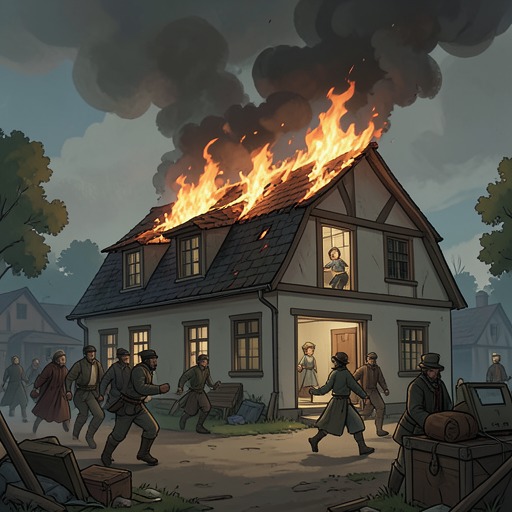
The fire occurred on September 28, 1868, while jam was being prepared in the Lothringer garden. Half the city burned, and Docteur Anger lost his wife, Adèle’s mother. He never recovered from that loss. The narrator explains the absence of jam from the household table as a consequence of this grief: an ordinary food was excluded because it belonged to the circumstances of the disaster.
Stefania’s parents lived in a poor adjoining house and died in the same fire. Neighbors rescued Stefania and Adèle and returned them together to Docteur Anger, wrapped in soot-stained, smoke-smelling cloths. The two girls thus entered his household through the same catastrophe, though their positions within it were unequal: Adèle was his daughter, while Stefania was an orphan whose continued place in the family would later become a point of painful ambiguity.
The Fire’s Return in Dreams
For more than twenty years, until his death, Docteur Anger cried out in his sleep because he dreamed of a fire. The cries were continuous and terrifying, shifting among several forms: at times he sounded like a siren, an owl, a locomotive, or a current of air. The changing voices make the nightmare less a single remembered scene than a force that takes over his sleeping body and gives the old catastrophe new sounds.
His dreams also turn the operating theatre into a place of disquieting substitution. In one recurring dream, he makes a precise incision in a patient without blood appearing; the person whose life should be saved proves instead to be a doll stuffed with straw and rubbish. The medical gesture remains exact, but its object is emptied of human life. This image joins his professional identity to the dream’s unsettling transformation of people into damaged or lifeless objects.
The recollection of these nightmares is framed through Stefania’s childhood memories and her later account. When Docteur Anger was caught between sleep and waking, she tried to calm him: she stroked his soaked head, brought him water and a calming mixture from a blue bottle, wiped his head and chest, and changed the wet sheets. It was only in this half-awake state that she could question him about the fire. Her caregiving places a child in the role of witness and caretaker, as the doctor’s unhealed trauma enters her earliest memories alongside his.
Fatherhood, Care, and Loss
Docteur Anger’s relation to Stefania is neither simply that of employer nor of biological parent. He saved her from the fire, raised her from early childhood, and provided her with a roof, food, and clothes. He also arranged for her and Adèle to attend Queen Hedwig’s school for girls. Stefania remembers that he did not have to secure an education for a poor Ruthenian orphan, and she experiences the decision as a debt: she believes she already owed him everything.
Her account of the school also reveals what she wanted from his care. Rather than remain among girls she regarded as dressed like dolls, Stefania would have preferred to stay at home near Docteur Anger while he worked in his study, bringing him coffee with cream and carefully pouring ink into a narrow-necked crystal inkwell. Her preferred closeness took the form of small acts of service. Education widened the life he made possible for her, but in memory the household and proximity to the doctor remain the focus of her longing.
When Mademoiselle Zuza proposed buying Stefania from him, Docteur Anger reacted with anger and rejected the idea of selling a living person. As Adèle later recounted his response, he insisted that he would not give up Stefania, whom he had rescued from the fire and raised as part of the household. He compared her place in the family to that of the gold watch inherited from his father. For Stefania, hearing the story was overwhelming: she understood the comparison as proof that he loved her and that she was precious to him. Adèle, however, framed the refusal in practical terms, pointing to the effort invested in Stefania’s upbringing and the inconvenience of training another servant. Their differing readings expose a central tension in Docteur Anger’s care: Stefania can be both cherished and valued for the service she performs.
The Watch and Inherited Memory
The gold Tissot watch condensed several kinds of inheritance in Docteur Anger’s household. It sat in the right pocket of his waistcoat, although he was left-handed, and a fine gold chain connected it to a button bearing a charm shaped like a small birdcage with a tiny bird inside. The watch had come to him from his father at their parting, when the Swabians of Neudorf left their homes in long lines of carts and carriages, some heading west toward the Atlantic and others east toward the Russian Empire.
Stefania remembers scratches and nearly invisible, web-like lines on the watch’s gold case. When Docteur Anger allowed her to hold it, its warmth and the pulse of its mechanism seemed to her like the beat of a small, courageous heart. She pressed it to her cheek, forehead, or the hollow at the base of her neck, finding calm in its warmth. The object therefore carried both a family history that preceded her and a bodily comfort that she associated with the doctor himself.
After his death, Stefania tells Père Josef the watch’s story while in his embrace. She had taken its ticking for so long as a sound of intimacy that she mistakes the living priest’s heartbeat, stomach, breath, and swallowing for the familiar mechanism. The memory of the watch thus reveals how Docteur Anger’s legacy persists not only in the objects he left behind but in the physical forms of comfort through which Stefania understands attachment.
Deathbed Charge and Lasting Consequences
Docteur Anger’s final instruction gives explicit form to Stefania’s dependence on Adèle. As he lay dying, he compared the two women to trees whose trunks had grown entangled and told Stefania to think of Adèle and of her own life, then to serve Adèle. Stefania did not hear the end of the sentence clearly; she inferred it while he struggled to breathe, his face turning blue and foam gathering at the corners of his mouth. He gripped her hand so tightly that her bones cracked before he died.
Stefania remembers his body after death as a dried-out doll in the doctor’s clothes, an image that echoes the straw-filled doll in his dreams. The resemblance gives the novel’s recurring object a grim reversal: in the dream, Docteur Anger operates on an apparent patient who becomes a doll; at his bedside, Stefania sees the dead doctor himself as an emptied figure. What remains animate for her is not his body but the command she has heard. She describes the words as continuing to pulse through her veins, driving her through task after task, each one like a prayer for Adèle.
That instruction later shapes Stefania’s sense of what leaving would mean. She imagines withdrawing to a convent or taking work as a companion to an old woman, yet sees departure as abandonment: she believes the anemic, migraine-prone Adèle cannot manage ordinary tasks and might injure herself or cause a disaster. The fear belongs to Stefania’s account of their bond, but its force is inseparable from the doctor’s last charge. His dying words turn service into both devotion and constraint, making the life he once protected for Stefania difficult for her to claim as her own.
Narrative Role
Docteur Anger is largely reconstructed through memory: Stefania’s recollections of his care, his nightmare cries, the watch, and his deathbed instruction supply the central contours of his character. The narrative does not present his grief as a resolved past. The fire returns in sleep for decades, while its consequences remain visible in household practice, family loss, and Stefania’s sense of obligation.
His character also gathers the novel’s contrasts between medical knowledge and experiences that resist easy explanation. He is a physician whose operating dreams turn a patient into a doll, and a grieving father whose final wish becomes a lasting rule in Stefania’s life. His care is concrete—rescue, schooling, food, shelter, protection from being sold—yet the same household dependence leaves Stefania bound to serve. In this way, Docteur Anger’s legacy is not a single verdict on whether he loved her, but the unresolved conjunction of protection, affection, grief, and obligation that survives him.